HEALTHY
Reference counterfactual
No degradation. Paired reference counterfactual.
RACS V1
RACS V1 evaluates whether observable operational degradation in an AMR-based warehouse can be detected early enough for a separate coordination layer to intervene before or during downstream propagation.
Research question
Can a separate risk-aware coordination layer use observable operational signals to intervene during progressive AMR degradation before or during broader system propagation?
System model
Experimental conditions
HEALTHY
No degradation. Paired reference counterfactual.
REACTIVE BASELINE
Degrading robot remains available until hard failure. At hard failure, stranded work is requeued and reassigned.
RACS
Observable task behavior can trigger predictive drain before hard failure. The robot receives no new work while its existing task may complete. After drain completion it is cordoned. Hard-failure fallback remains available.
Observable-signal integrity
Seeded robustness design
For each seed and WIP condition, healthy, reactive-baseline, and RACS runs use the same workload realization and shared non-treatment configuration.
| Design parameter | Frozen V1 value |
|---|---|
| Seeds | 30 |
| Seed range | 1000 through 1029 |
| WIP conditions | 0, 1, 2, 4 |
| Conditions | healthy / reactive baseline / RACS |
| Total simulation runs | 360 |
| Tasks per workload | exactly 51 |
| Max arrivals per step | 2 |
| Randomized factor | only arrival timing |
| Pairing | same arrival sequence for paired conditions |
| Automated tests | 248 |
Hypotheses
Metrics
Metrics are grouped by analysis role; not all metrics showed improvement.
Results
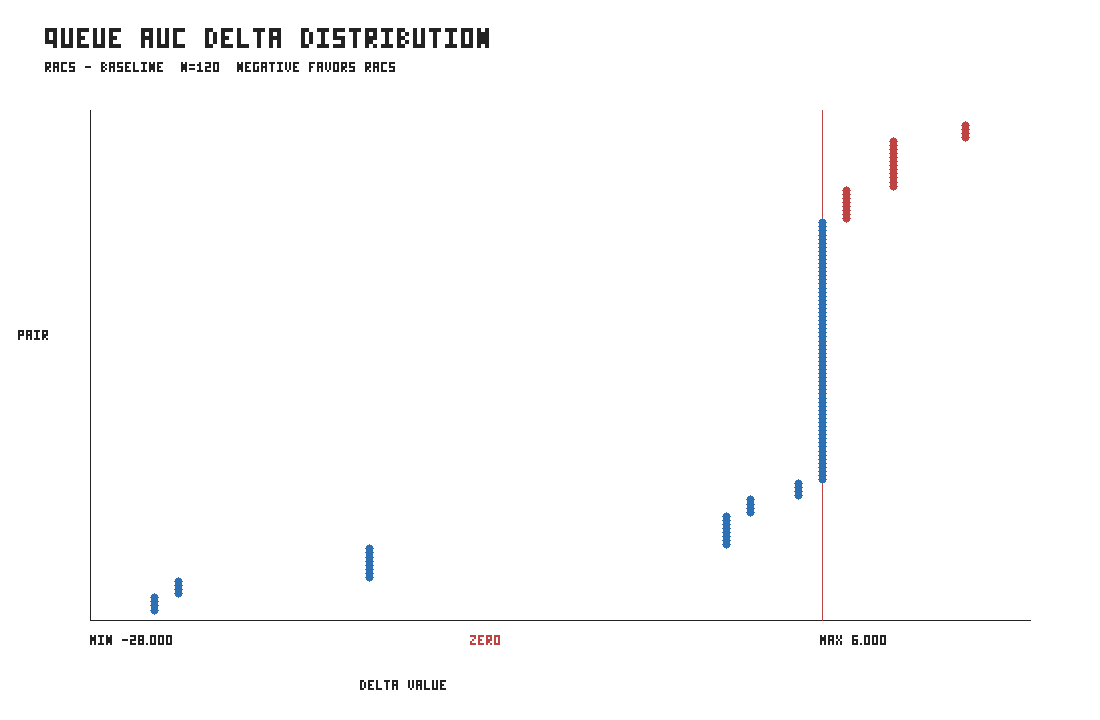
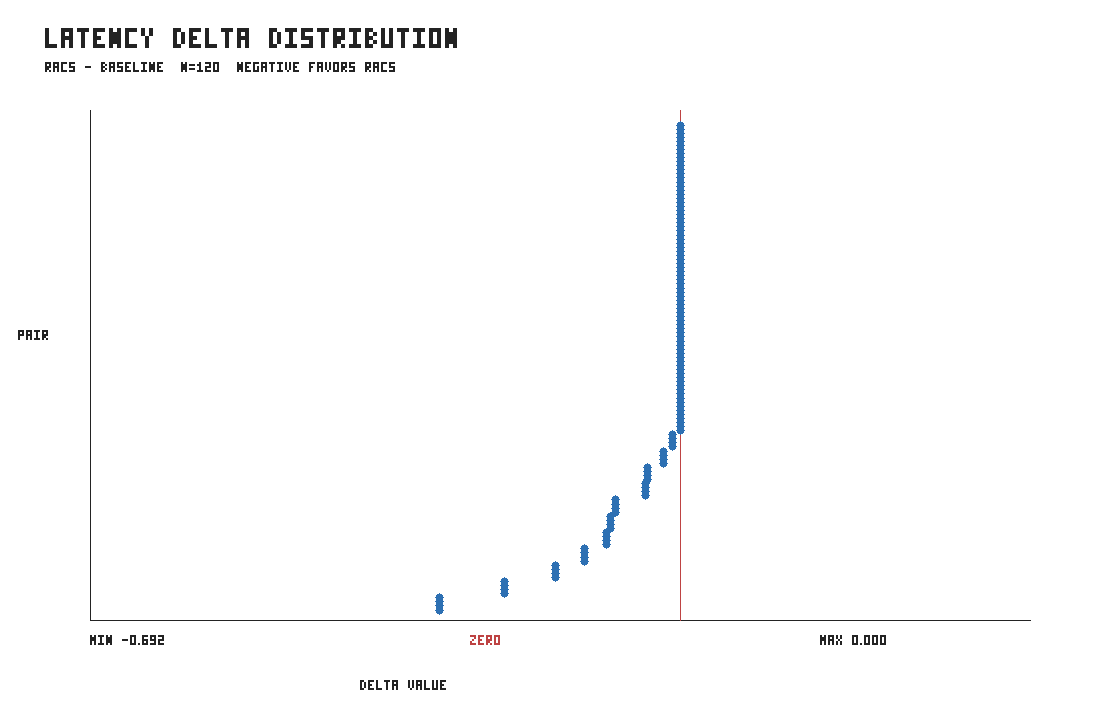
Lower queue AUC and lower latency are favorable.
Mean queue AUC delta, RACS − baseline
-2.9333
Mean latency delta, RACS − baseline
-0.0901
Queue AUC regressions
24 / 120 paired comparisons
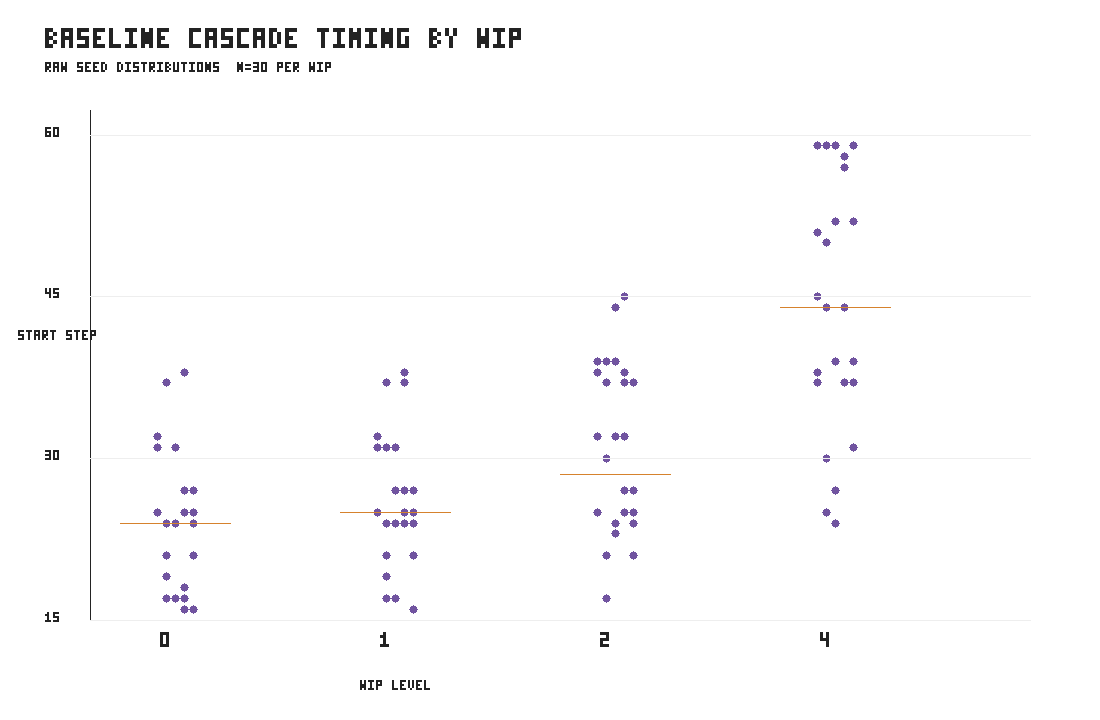
| WIP | Min | Median | Max |
|---|---|---|---|
| WIP 0 | 16 | 24 | 38 |
| WIP 1 | 16 | 25 | 38 |
| WIP 2 | 17 | 28.5 | 45 |
| WIP 4 | 24 | 44 | 59 |
H2 is not established because the intervention-before-propagation group did not show greater downstream benefit than the at/after group.
Group A
n = 100
Group B
n = 20
Experiment figures
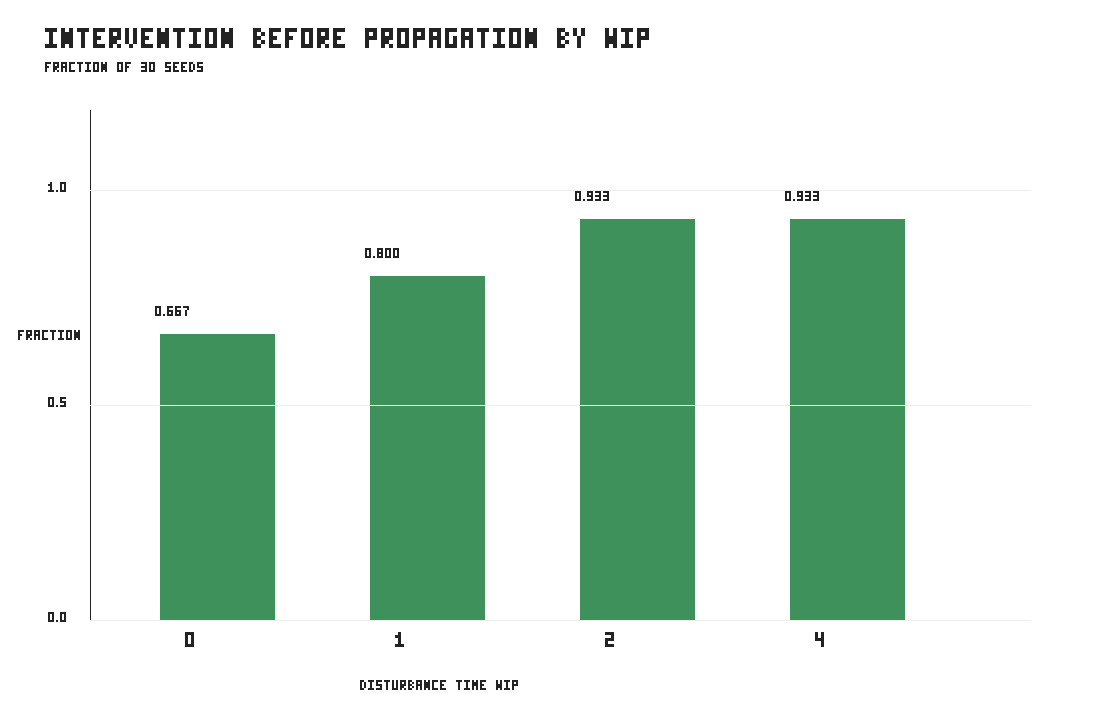
Higher disturbance-time WIP was associated with more frequent intervention before baseline propagation within the tested WIP levels.
Mean queue AUC favored RACS, while 24 of 120 paired comparisons worsened.
Mean task latency favored RACS across the seeded study.
Baseline propagation timing varied by seeded arrivals and shifted later at higher disturbance-time WIP.
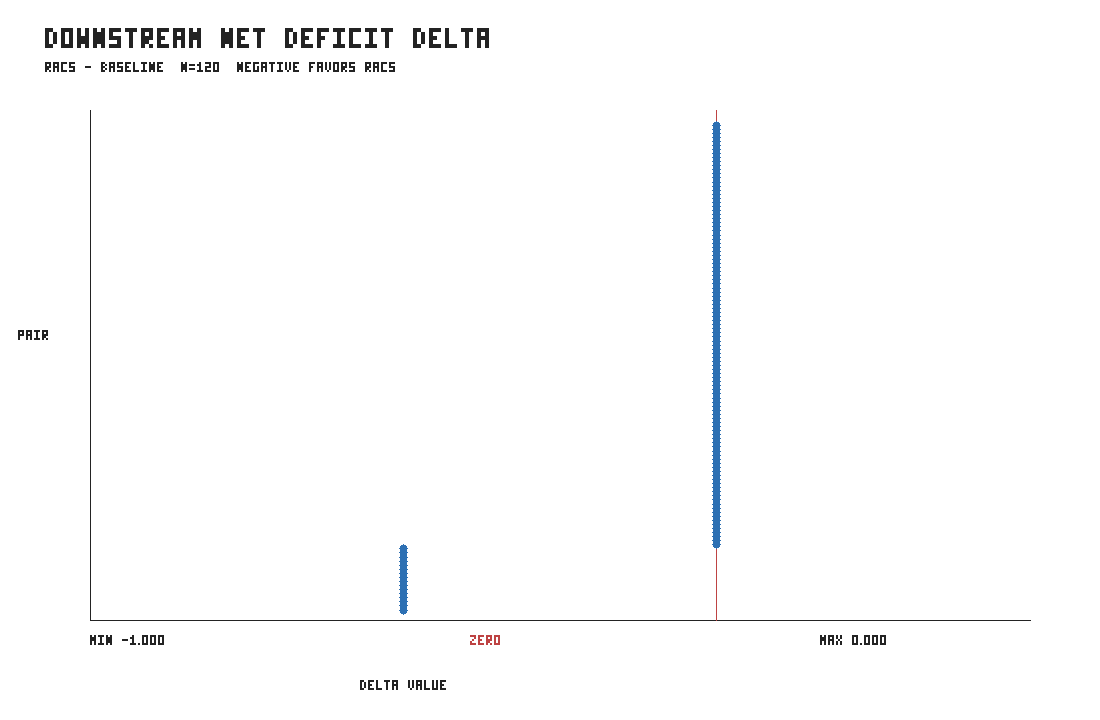
Downstream deficit deltas did not establish H2's earlier-intervention benefit relationship.
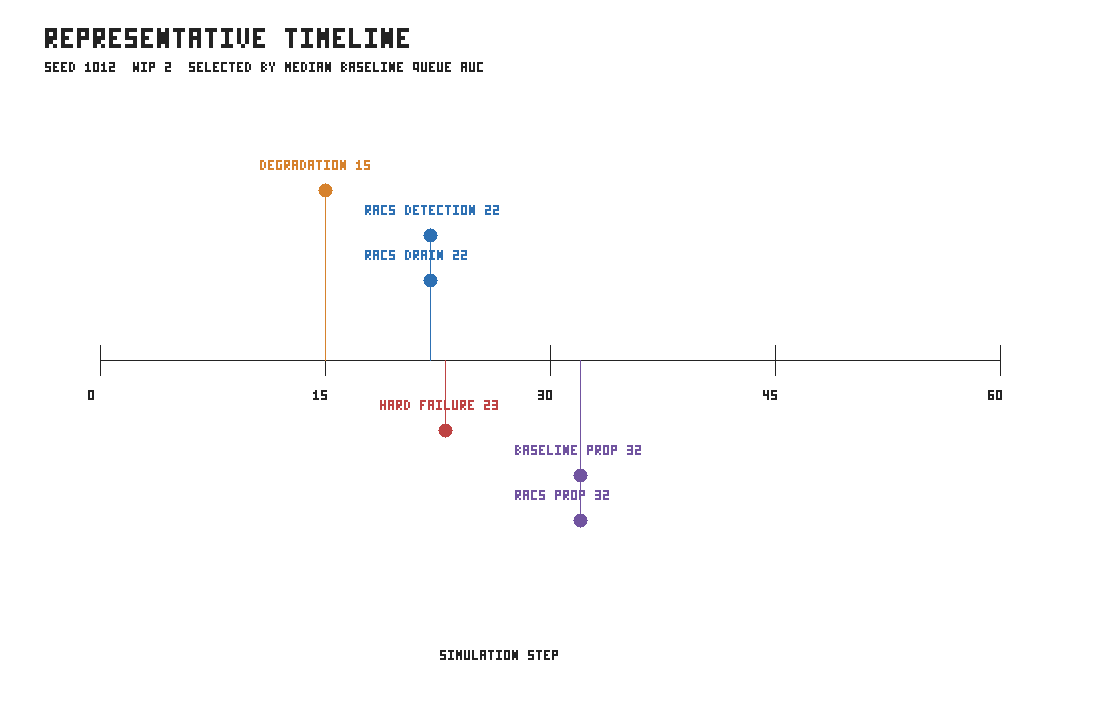
The representative WIP 2 case shows the event sequence available in the frozen result artifact.
Negative cases
Interpretation
No significance claims are made.
H1 — Transport coordination
PARTIALLY SUPPORTEDPartially supported. Mean transport metrics favored RACS, but not every paired realization improved.
H2 — Earlier intervention and downstream benefit
NOT ESTABLISHEDNot established. Earlier intervention did not produce greater downstream benefit in this V1 study.
H3 — Intervention headroom
SUPPORTED WITHIN TESTED WIP LEVELSSupported within tested WIP levels. Higher disturbance-time WIP was associated with a greater fraction of runs where RACS intervened before propagation.
Limitations
Reproduction
The reproduction creates a new result directory and does not overwrite the frozen reference artifacts.
git clone https://github.com/ridwanbale/racs-protocols.git
cd racs-protocols
python -m venv .venv
Set-ExecutionPolicy -Scope Process -ExecutionPolicy Bypass
.\.venv\Scripts\python.exe -m pip install --upgrade pip
.\.venv\Scripts\python.exe -m pip install -e ".[dev]".\.venv\Scripts\python.exe -m simulations.experiments.racs_v1 `
--seeds 30 `
--first-seed 1000 `
--output results `
--experiment-id seeded_robustness_30_reproduction.\.venv\Scripts\python.exe -m simulations.experiments.plot_racs_v1 `
--result-dir results\seeded_robustness_30_reproduction `
--output-dir docs\experiments\figures\racs_v1_reproductionUse the version and release identifiers below when referring to a specific evaluation of RACS V1.